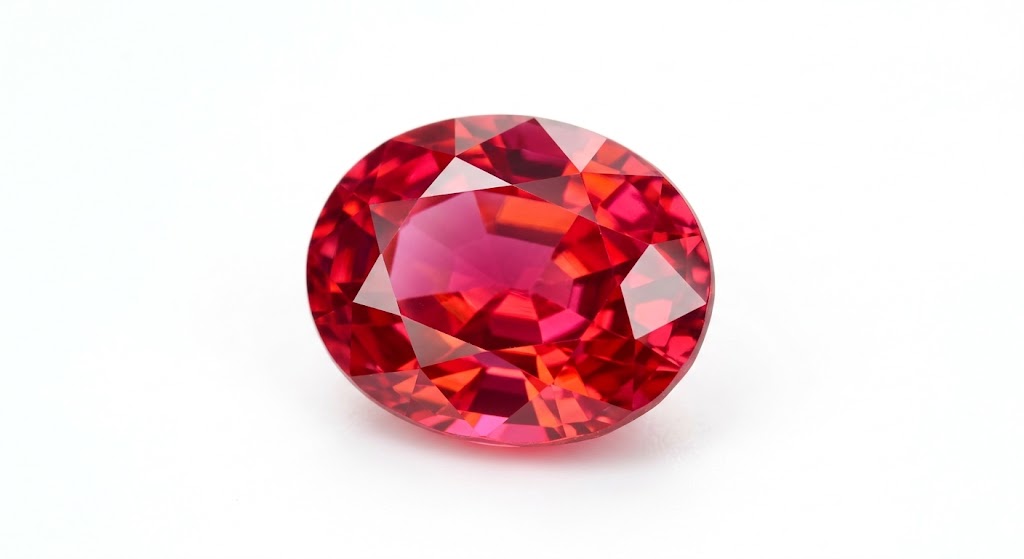
Spinel — Historical Treasure of Royal Crowns, Fiery Luster, and Master's Secrets
Spinel (MgAl2O4\text{MgAl}_2\text{O}_4MgAl2O4) is a noble and highly precious mineral belonging to the oxide class. For centuries, red spinel so closely resembled ruby that it was mistakenly referred to by monarchs and jewelers as "Balas Ruby." Only in the late 18th century, with the advancement of chemical analysis, were spinel and corundum (ruby/sapphire) officially distinguished as separate mineral species.
Through the eyes of a master craftsman, spinel is a true jeweler's dream. It possesses high hardness, optical isotropy (single refraction, which renders its color exceptionally pure and vivid), and remarkable mineralogical diversity.
Origin of the Name: The name "spinel" is believed to derive from the Latin word "Spina" (spine/thorn), referring to the pointed, faceted octahedral shape of its crystals.
Royal Mistakes in History: Some of the world's most famous "rubies" were later identified as magnificent red spinels:
"The Black Prince's Ruby": An undrilled 170-carat red spinel set into the British Imperial State Crown.
"The Timur Ruby": A historic 361-carat spinel, also housed in the British Royal Collection.
The Great Imperial Crown of Russia Spinel: Catherine the Great's crown is surmounted by a unique 398.72-carat red spinel.
Energy and Spiritual Significance: In lithotherapy, spinel is regarded as a stone of vitality, passion, and success. Red spinel connects with the Root (Muladhara) chakra, while the rare cobalt blue variety aligns with the Throat (Vishuddha) and Third Eye (Ajna) chakras. It is believed to grant physical strength, inspiration, and a positive mindset to its owner.
When working with spinel, a lapidary artist must take into account its optical isotropy and high thermal stability.
Chemical Formula: MgAl2O4\text{MgAl}_2\text{O}_4MgAl2O4 (Magnesium aluminate).
Crystal System: Cubic (commonly forms ideal octahedrons and dodecahedrons).
Hardness (Mohs Scale): 8.0 (Exceptionally high hardness; ideal for everyday jewelry).
Density: 3.58−3.61 g/cm33.58 - 3.61 \text{ g/cm}^33.58−3.61 g/cm3
Cleavage: None (Highly resistant to mechanical fracture).
Refractive Index: 1.712−1.7621.712 - 1.7621.712−1.762
Optical Character: Isotropic (Singly Refractive) — lacks pleochroism (color shift at different angles), ensuring uniform color distribution.
Color: Red (due to chromium traces), pink, purple, blue/cobalt blue (from iron and cobalt traces), green, orange ("Jeddah"), black (hercynite/pleonaste).
Luster: Vitreous, intense.
Myanmar (Burma - Mogok): The historic source for the world's finest "Flame Red" and intense pink spinels.
Sri Lanka: Celebrated for a wide palette of colors (purple, pink, blue, and fancy tones).
Tajikistan (Kuh-i-Lal): The historic Pamir mountain source of legendary "Balas rubies."
Vietnam (Luc Yen): Renowned for unique neon-pink and rare cobalt-blue spinels.
Tanzania (Mahenge): Famous for the vibrant, electric neon pinkish-red spinels discovered in the 2000s.
High Jewelry: Spinel is currently one of the fastest-growing and most sought-after gemstones in the market. It is featured in exclusive gold and platinum creations (rings, earrings, necklaces).
Collecting: Natural, untreated red, Mahenge pink, and cobalt-blue spinels command prices on the collector market that rival fine corundum.
Faceting and Cutting: Since spinel lacks cleavage and is optically isotropic, it is very rewarding for lapidary work. To showcase its color and dispersion best, it is fashioned into ovals, cushions, octahedrons (following natural crystal outlines), or pears.
Untreated Authenticity: The vast majority of spinels on the market are completely natural — they rarely undergo heat treatment or chemical enhancement, which adds significantly to their intrinsic value.
Care and Maintenance:
Caution: With a high hardness of 8.08.08.0, spinel is exceptionally durable, scratch-resistant, and ideal for daily wear.
Cleaning: Easily cleaned with warm soapy water and a soft brush. Ultrasonic and steam cleaning are generally safe (provided the gem lacks major open fractures).
 511 40 73 13
 info@silveria.ge


 Eng