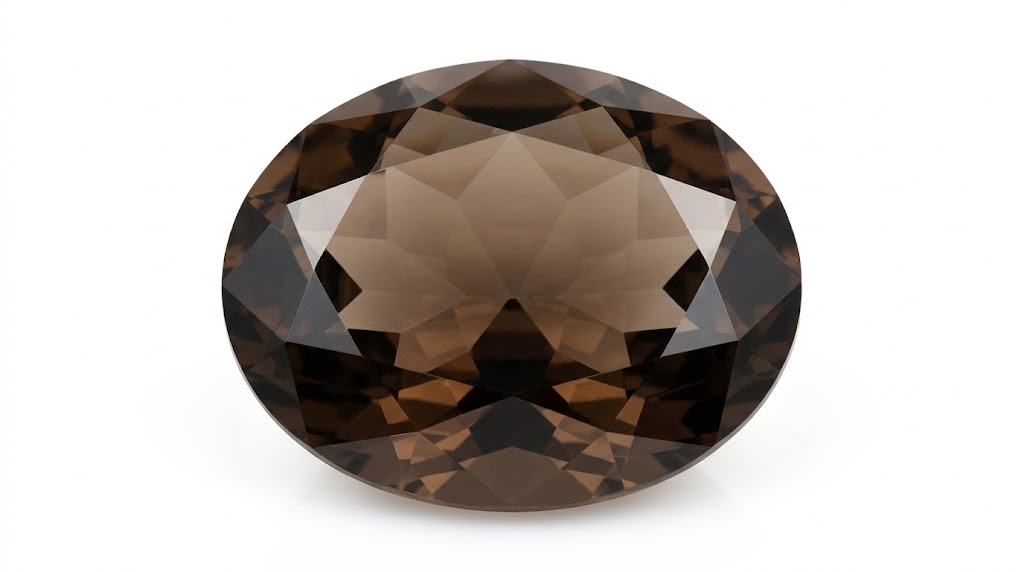
Smoky Quartz — Mystery of the Subterranean Realm, Silky Mysticism, and Master's Secrets
Smoky quartz ($\text{SiO}_2$) is one of the most widely recognized and captivating varieties of the quartz family, distinguished by its translucent brownish, grayish-brown, to nearly black smoky hues. Historically, it was often erroneously referred to as "Rauchtopaz" (German Rauch — smoke); however, gemologically it shares no relationship with topaz, being pure quartz.
Through the eyes of a master craftsman, smoky quartz is an outstanding material for both faceted designs and ornamental lapidary carving. Its high clarity, abundant size, and ease of processing allow for the creation of grand jewelry pieces as well as refined collector specimens.
Scottish "Cairngorm": Sourced for centuries in the Cairngorm Mountains of Scotland, smoky quartz was traditionally used to adorn Scottish jewelry, Highland dirk handles, and kilt brooches. It is regarded as the national gemstone of Scotland.
Chinese Sunglasses: In 12th-century China, flat slabs of smoky quartz were fashioned into early "sunglasses" — not only to block glare, but also to conceal facial expressions of judges during court proceedings.
Energy and Spiritual Significance: In lithotherapy, smoky quartz is prized as a powerful grounding and protective stone. It is deeply linked to the Root (Muladhara) chakra. It is believed to absorb negative energy, alleviate stress, anxiety, and depression, while instilling emotional stability and rational thinking in its owner.
When working with smoky quartz, a lapidary artist must consider the nature of its color origin and its sensitivity to heat.
Chemical Formula: $\text{SiO}_2$ (Silicon dioxide).
Crystal System: Trigonal (commonly forms well-defined hexagonal prisms).
Hardness (Mohs Scale): 7.0 (High hardness; resistant to scratches).
Density: $2.65 \text{ g/cm}^3$
Cleavage: None (Conchoidal fracture).
Refractive Index: $1.544 - 1.553$
Color Origin: Color is caused by natural or artificial gamma radiation acting on aluminum ($\text{Al}^{3+}$) impurities within the quartz crystal lattice.
Color: Light smoky-brown, honey-brown, deep chocolate-brown, and near-black (the extremely dark, nearly opaque variety is known as morion).
Luster: Vitreous.
Pleochroism: Weak to moderate (brown to reddish-brown).
Brazil (Minas Gerais): The world's primary producer, yielding giant crystals of superb clarity.
Madagascar: Celebrated for high-grade smoky quartz with rich color saturation.
USA (Colorado - Pikes Peak): Famous for iconic collector specimens featuring smoky quartz intergrown with amazonite.
Swiss Alps, Scotland, Namibia, and Russia (Urals).
Jewelry Art: Extensively featured in all types of jewelry (rings, earrings, pendants, bracelets). Large faceted stones set in silver or gold mountings are especially popular.
Lapidary Carving & Engraving: Utilized for carving spheres, figurines, wax seals, and decorative vessels.
Collecting: Aesthetic crystal clusters (druses) enjoy immense popularity among mineral collectors.
Thermal Sensitivity: When heated to elevated temperatures ($200^\circ\text{C} - 400^\circ\text{C}$), smoky quartz loses its brown tone and turns yellow or colorless (citrine-like). Jewelers must avoid applying direct flame during soldering.
Faceting and Polishing: Because raw material is affordable and abundant in large sizes, lapidaries have great freedom to execute complex, creative fantasy cuts.
Care and Maintenance:
Caution: A hardness of $7.0$ ensures excellent durability, though it should still be protected from sharp impacts.
Cleaning: Very easy to maintain. Clean using warm soapy water and a soft brush. Ultrasonic cleaning is safe.
 511 40 73 13
 info@silveria.ge


 Eng