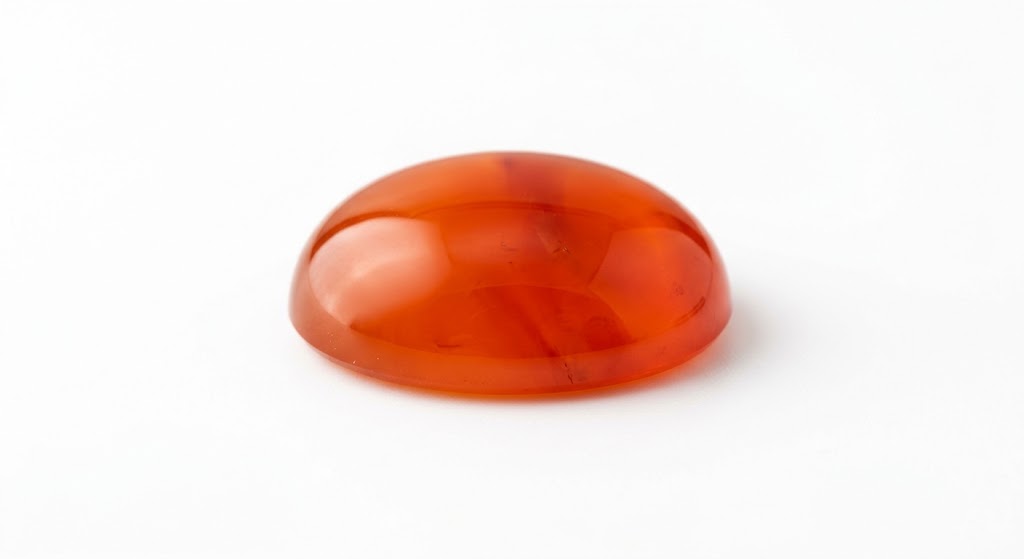
Carnelian (Sardion) — Solar Warmth, Historic Seals, and Master's Secrets
Carnelian ($\text{SiO}_2$) is a reddish-orange, flesh-red, to brownish-red translucent variety of cryptocrystalline quartz — chalcedony. Its vibrant, warm coloration is imparted by microscopic inclusions of iron oxide (hematite). The name "carnelian" likely traces back to the ancient Lydian city of Sardis (whence sard) or the Latin word "Caro" (flesh), reflecting its characteristic hue.
Through the eyes of a master craftsman, carnelian is one of the most historically revered and gratifying materials for glyptic art (gem carving) and lapidary work. It exhibits high toughness, lacks cleavage, and takes a superior polish, enabling the creation of refined cabochons as well as intricate relief carvings (gems, intaglios, and cameos).
Ancient Civilizations: Carnelian ranks among humanity's earliest ornamental gemstones. In Mesopotamia, the Indus Valley Civilization (Harappa), and Ancient Egypt, it was widely used for fashioning beads, amulets, and signet rings. Egyptians termed it "the setting sun stone" and associated it with the cult of Isis.
Signet Rings: In the Roman Empire and the Middle Ages, carnelian was the premier choice for carving personal signets (intaglios). Due to a unique physical property — melted sealing wax does not adhere to polished carnelian — it was indispensable for sealing confidential correspondence.
Notable Historical Figures: Carnelian signet rings were worn by the Prophet Muhammad, Napoleon Bonaparte, and Alexander Pushkin.
Energy and Spiritual Significance: In lithotherapy, carnelian is regarded as a stone of vital energy, creative inspiration, and courage. It is closely linked with the Sacral (Svadhisthana) and Solar Plexus (Manipura) chakras. It is believed to enhance blood circulation, protect its owner from envy and negative emotions, and bestow inner tranquility and oratorical skill.
When working with carnelian, a lapidary artist must take into account its fibrous microstructure and its capacity for color enhancement when exposed to sunlight or heat.
Chemical Formula: $\text{SiO}_2$ (Silicon dioxide — Chalcedony group with iron oxide impurities, primarily $\text{Fe}_2\text{O}_3$).
Crystal System: Trigonal (microcrystalline/cryptocrystalline aggregates).
Hardness (Mohs Scale): 6.5 - 7.0 (High hardness; highly resistant to scratching).
Density: $2.58 - 2.64 \text{ g/cm}^3$
Cleavage: None (Waxy or conchoidal fracture).
Refractive Index: $1.530 - 1.540$
Color: Orange-red, chestnut, brownish-red, flesh-pink (the darker brownish-red variety is frequently designated as sard).
Luster: Waxy to silky, turning vitreous upon polishing.
Diaphaneity: Translucent to nearly opaque.
India (Gujarat - Ratanpur): The historic source for the world's finest, high-grade orange-red carnelian for centuries.
Brazil and Uruguay: The largest global suppliers of raw material (frequently mined alongside agates).
Madagascar: Renowned for rich, intensely saturated specimens.
USA (Oregon, Washington), Australia, Russia (Siberia, Crimea), and Botswana.
Jewelry Art: Featured in rings, earrings, pendants, and bracelets (predominantly as cabochons, flat plates, and beads). It pairs exceptionally well with sterling silver and yellow gold.
Glyptic and Relief Carving: Fashioning cameos, intaglios, seal rings, and small sculptural carvings.
Decorative and Collector Spheres: Carved decorative vessels, caskets, and protective amulets.
Thermal Color Enhancement: Known since antiquity, exposing carnelian to sunlight or slow thermal treatment ($150^\circ\text{C} - 250^\circ\text{C}$) converts iron hydroxides into hematite, shifting the color to a far more vibrant and saturated red. Lapidaries must ensure heating is gradual to prevent thermal shock fractures.
Processing and Polishing: Carnelian's absence of cleavage and high toughness make it an exceptional candidate for detailed carving and shaping. A lustrous waxy-to-vitreous sheen is best achieved using diamond paste or cerium oxide polish.
Care and Maintenance:
Caution: A hardness of $6.5-7.0$ ensures high durability for daily wear, though it should be safeguarded against harsh chemicals and sharp impacts.
Cleaning: Easily cleaned using warm soapy water and a soft cloth. Ultrasonic cleaning is safe (provided the gemstone is free of deep fractures).
 511 40 73 13
 info@silveria.ge


 Eng