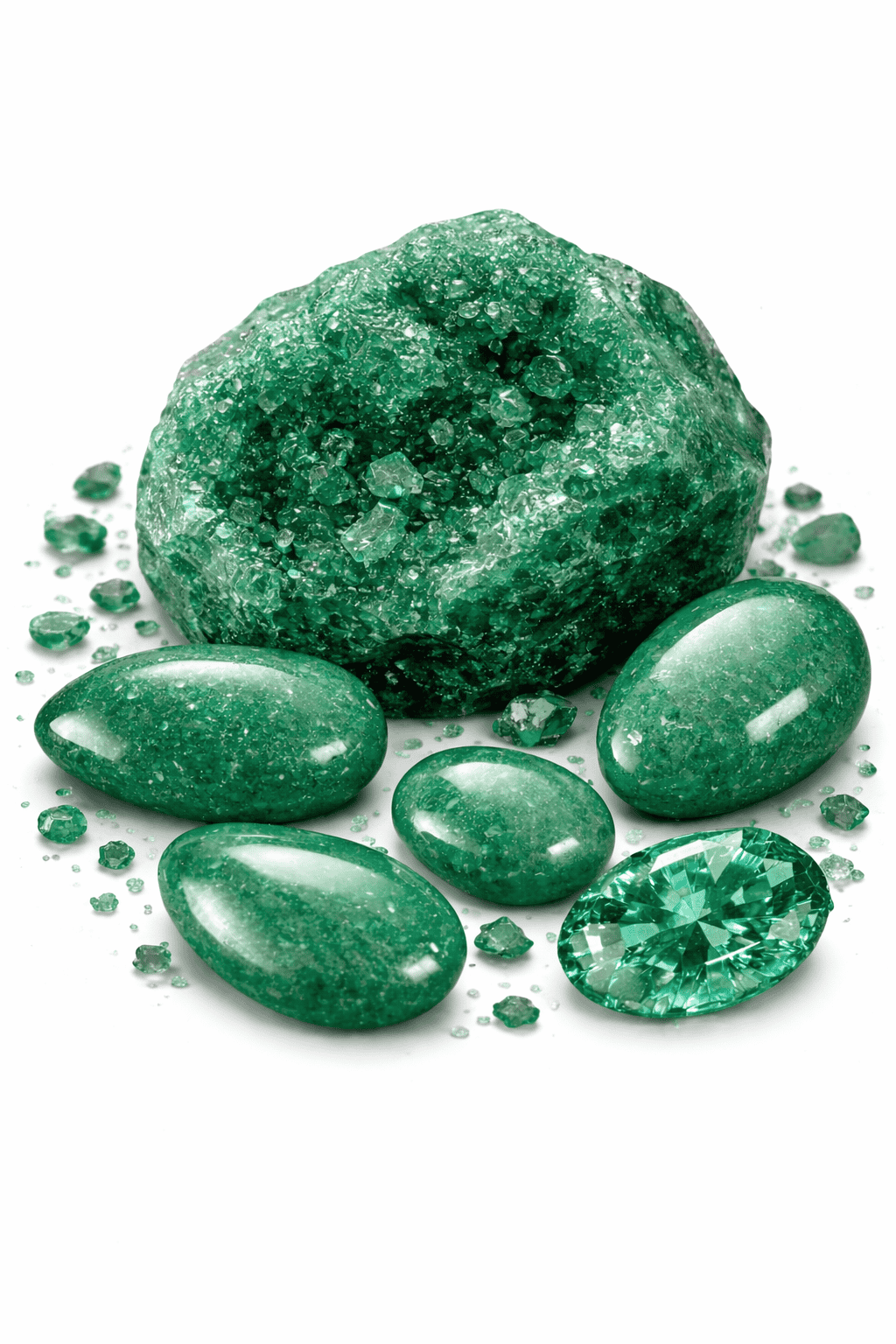
Aventurine rivals other natural stones with its unique beauty. According to an old legend, it was accidentally created in a Venetian workshop when sparkling particles fell into a thin layer of glass. In reality, aventurine is a fine-grained variety of quartz, cherished across cultures for centuries.
In China, it was called the “Stone of Emperors,” as royal seals were carved from it.
In India, aventurine was considered a protective talisman, guarding its wearer from misfortune.
In Europe, it arrived from India and was widely used to create jewelry and decorative objects, including urns and furniture accents.
Aventurine is semi-transparent or fully opaque, with a glassy, sparkling luster.
Hardness: 7 on the Mohs scale — a remarkably durable stone.
Its color varies depending on inclusions, such as rutile, apatite, and sphene.
Blue Aventurine — resembles a night sky filled with stars.
Dark Red — distinguished by its transparency and sparkle.
Yellow — the brightest type, with a honey-like gradient.
Brown — the toughest of all varieties.
Green — even in color, strong and durable.
White — features dark red inclusions; often imitated.
Pink — beautiful hue, but less sparkling.
Striped Chameleon — changes color depending on lighting; golden streaks add extra brilliance.
Supports the nervous system, regulates blood pressure, and aids digestion.
Cleanses the body of toxins and impurities.
Helps treat skin imperfections, rashes, and promotes healing.
Green aventurine (worn as a bracelet or ring) can aid in recovery from depression and protect family relationships.
Aventurine attracts positive energy, luck, and happiness.
Its effects vary by color:
Green — love, family harmony.
Blue — protection from danger.
Black — used for insight into the subconscious; powerful in rituals for psychics.
Zodiac Connections:
Virgo — enhances sensitivity, helps overcome challenges.
Taurus & Cancer — beneficial influence.
Fire signs (Leo, Sagittarius, Aries) — not recommended, may overstimulate emotions.
Green Aventurine — India, popular for jewelry.
Yellow Aventurine — primarily found in America.
Also mined in Europe, Asia, Australia, and Brazil.
 511 40 73 13
 info@silveria.ge


 Eng
Eng