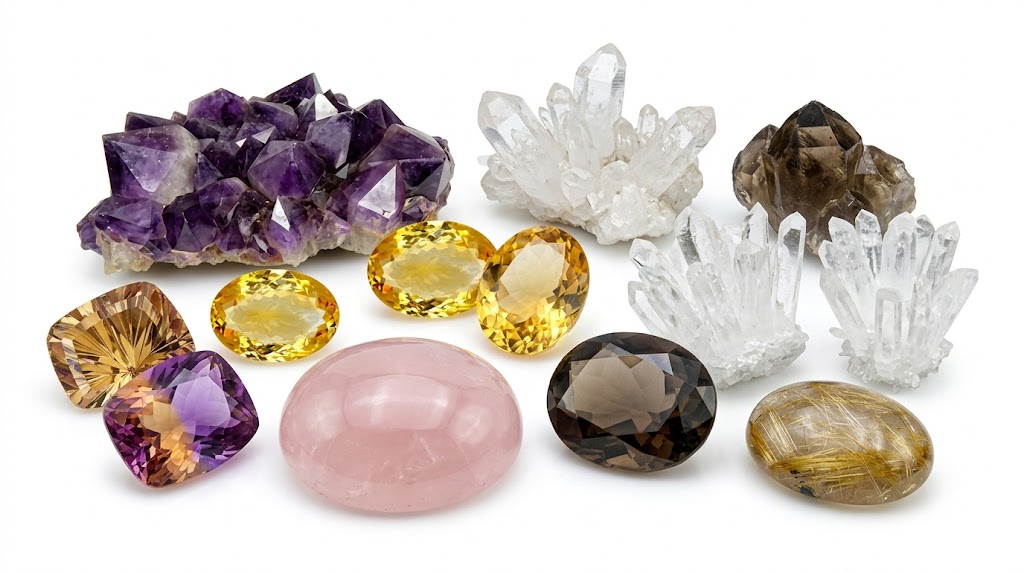
Quartz — Heart of the Earth's Crust, Mineralogical Diversity, and Master's Secrets
Quartz ($\text{SiO}_2$) is one of the most abundant and diverse minerals in the Earth's crust. It forms a vast family of precious, semi-precious, and ornamental stones. Quartz is divided into two primary groups: macrocrystalline (well-defined, large crystals) and cryptocrystalline / microcrystalline (the chalcedony group — fibrous or granular aggregates).
The quartz group serves as the foundation of jewelry and lapidary art. Its high hardness ($7.0$), absence of cleavage, and rich color palette make it an ideal material for both faceting and artistic carving or sculpture.
Origin of the Name: The word "quartz" originates from the German "Quarz" (likely of West Slavic origin, meaning "hard"). Ancient Greeks referred to transparent quartz as "Krystallos" (ice), believing it to be ice permanently frozen by the gods.
Energy and Spiritual Significance: In lithotherapy and esotericism, quartz is regarded as a primary energy amplifier and conductor. Clear quartz (rock crystal) connects with the Crown (Sahasrara) chakra and is considered a "master healer" that harmonizes all other energy centers.
Chemical Formula: $\text{SiO}_2$ (Silicon dioxide).
Crystal System: Trigonal / Hexagonal.
Hardness (Mohs Scale): 7.0 (Reference hardness; cannot be scratched by steel).
Density: $2.65 \text{ g/cm}^3$
Cleavage: None (Conchoidal fracture).
Refractive Index: $1.544 - 1.553$
Luster: Vitreous, waxy (in chalcedonies).
Piezoelectricity: Exhibits a piezoelectric effect — generates an electric pulse under mechanical stress (widely utilized in timepieces and electronics).
1. Macrocrystalline Quartzes
Rock Crystal: Completely colorless, water-clear quartz.
Properties: High clarity and light transmission. Used in jewelry, optics, and decorative lapidary carving.
Amethyst: The most precious, violet/purple variety of quartz (color is caused by iron ($\text{Fe}^{3+}$) impurities and natural irradiation).
Properties: Weak pleochroism; prolonged exposure to direct sunlight may cause color fading.
Citrine: Yellow, golden, or orange-brown transparent quartz.
Properties: Rare in nature (most commercial specimens are produced by heat-treating amethyst).
Smoky Quartz: Brownish, grayish-brown, or chocolate-brown transparent quartz.
Properties: Heat-sensitive (loses color or turns yellow at $200^\circ\text{C} - 400^\circ\text{C}$).
Rose Quartz: Soft pink, often slightly hazy or translucent variety (color is imparted by micro-needles of titanium, manganese, or dumortierite).
Properties: Occasionally displays asterism (a star effect).
Morion: Black, nearly opaque quartz.
Properties: Contains structural defects caused by natural radiation.
Prasiolite: Rare, leek-green transparent quartz (frequently produced through specialized heat treatment of amethyst).
2. Cryptocrystalline Varieties (Chalcedony Group)
Chalcedony: Translucent, milky, bluish, or gray fibrous aggregate.
Carnelian / Sardion: Orange-red or flesh-red translucent chalcedony (contains hematite).
Chrysoprase: Bright apple-green chalcedony (color is driven by nickel inclusions). Considered the most valuable variety of chalcedony.
Agate: Multicolored chalcedony featuring banded, fortification, or zonal color patterns.
Jasper: Opaque, dense, iron-oxide-rich granular quartz occurring in numerous colors and patterns.
Bloodstone / Heliotrope: Dark green opaque jasper with red hematite spots.
3. Quartzes with Optical Effects (Quartz Eyes)
Tiger's Eye: Golden-brown chalcedony/quartz where crocidolite (amphibole) fibers are replaced by quartz and iron oxide (hematite/goethite). Displays a silky chatoyancy.
Hawk's Eye: The primary, unoxidized form of tiger's eye — featuring blue-gray or blue-black shades.
Bull's Eye: A thermally altered or naturally heated reddish-brown variety of tiger's eye.
4. Additional Specialty Varieties
Rutilated Quartz / "Venus Hair" (Hair Stone): Transparent quartz (typically rock crystal or smoky quartz) containing golden, reddish, silvery, or coppery needle-like crystals of rutile ($\text{TiO}_2$ — titanium dioxide). Frequently called "Venus Hair Stone" or "Cupid's Darts." The rutile inclusions form unique, unrepeatable geometric patterns within the gem.
Craftsman's Note: When cutting, orienting the stone properly is essential to maximize the needles' reflection and internal depth. Well-suited for both faceting (with large facets) and high-domed cabochons.
Aventurine: A fine-grained variety of quartz or chalcedony containing microscopic inclusions of fucshite (green chromium mica), hematite, or goethite. Displays an aventurescence effect — a bright, shimmering metallic glint from within the stone. Most commonly green (due to fucshite), but also occurs in orange, brown, blue, and reddish-brown.
Craftsman's Note: Takes a superb polish when fashioned into cabochons, beads, and spheres.
Lodolite / "Garden Quartz" (Scenic Quartz): Transparent rock crystal enclosing diverse internal mineral inclusions (chlorite, epidote, hematite, clay minerals). These inclusions create a striking visual illusion inside the stone — resembling a frozen underwater realm, a blooming garden, a coral reef, or a mountain landscape. Every specimen is entirely unique and one-of-a-kind.
Craftsman's Note: Processed exclusively as smooth, high-domed cabochons or fantasy cuts, where the polished dome acts as a magnifying lens that enhances the clarity and depth of the internal landscape.
Brazil: Global leader (producing amethyst, citrine, rock crystal, rose quartz, and smoky quartz).
Madagascar: High-grade rose quartz, amethyst, and agates.
Uruguay: Renowned for deep, richly saturated violet amethyst geodes.
Australia: The world's primary source of chrysoprase.
USA, Namibia, Zambia, Sri Lanka, and Russia (Urals).
Jewelry Industry: Used across all types of jewelry — from faceted gems (amethyst, citrine) to cabochons and beads (agate, carnelian, tiger's eye).
Lapidary Carving: Sculptures, caskets, cameos, and decorative vessels.
Industry and Technology: Quartz sand is used in glass, ceramics, and cement production; quartz crystals are essential in radio electronics, optics, laser technologies, and quartz timepieces.
Processing Advantages: A hardness of $7.0$ allows quartz to be easily cut, shaped, and polished to a durable, vitreous luster. Its lack of cleavage significantly minimizes the risk of fracturing during lapidary work.
Thermal and Light Sensitivity: Prolonged exposure to direct sunlight can cause fading in rose quartz and certain amethysts. High heat alters quartz colors (e.g., transforming amethyst into citrine).
Care and Maintenance:
Durability: Quartz jewelry is exceptionally durable for daily wear.
Cleaning: Clean easily with warm soapy water. Ultrasonic cleaning is generally safe for most varieties (except specimens with deep open fractures).
 511 40 73 13
 info@silveria.ge


 Eng