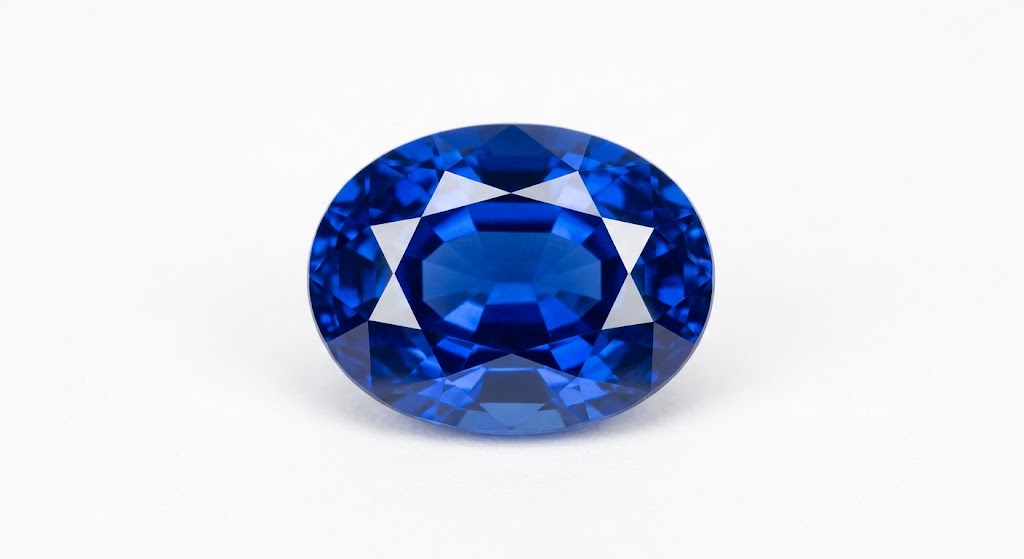
Sapphire — Blue Majesty, King of Corundums, and Master's Secrets
Sapphire ($\text{Al}_2\text{O}_3$) is a mineral of the corundum group and belongs to the world's "Big Four" precious gemstones (alongside diamond, emerald, and ruby). Gemologically, red corundum is called ruby, while all other colors of corundum — blue, pink, yellow, green, purple, or orange — are classified as sapphires. Deep, royal blue is considered the classic sapphire hue.
Through the eyes of a master craftsman, sapphire is one of the most flawless and durable materials in fine jewelry. Boasting the highest hardness after diamond ($9.0$), a brilliant vitreous luster, and a high refractive index, it endures through centuries while maintaining an immaculate polish.
Origin of the Name: The word "sapphire" stems from the Greek "Sappheiros" and Latin "Sapphirus" (likely derived from the Sanskrit "Sanipriya" — "dear to Saturn"). In antiquity, this name was also frequently used to refer to lapis lazuli.
Royal and Sacred Symbol: For centuries, sapphire was revered as the stone of monarchs and high clergy. European kings and popes wore sapphire rings as symbols of wisdom, purity, and divine protection. The most famous modern sapphire is Princess Diana's (now Catherine, Princess of Wales's) engagement ring featuring a Ceylon sapphire.
Energy and Spiritual Significance: In lithotherapy and esotericism, sapphire is regarded as a stone of tranquility, truth, and spiritual purity. It is closely connected to the Throat (Vishuddha) and Third Eye (Ajna) chakras. It is believed to soothe passions, heighten intuition, and protect its wearer from betrayal and envy.
When working with sapphire, a lapidary artist must account for its strong dichroism (pleochroism) and select the correct crystallographic axis during orientation and faceting.
Chemical Formula: $\text{Al}_2\text{O}_3$ (Aluminum oxide).
Crystal System: Trigonal (forms hexagonal prisms or bipyramids).
Hardness (Mohs Scale): 9.0 (The hardest natural mineral after diamond).
Density: $3.98 - 4.06 \text{ g/cm}^3$
Cleavage: None (Conchoidal or uneven fracture).
Refractive Index: $1.762 - 1.778$
Color Origin: Blue coloration is driven by intervalence charge transfer between iron ($\text{Fe}^{2+}$) and titanium ($\text{Ti}^{4+}$) impurities. Yellow sapphires contain iron alone, pink ones contain chromium, and the rare orange-pink variety (Padparadscha) contains a unique combination of chromium and iron.
Luster: Bright vitreous, approaching adamantine upon fine polishing.
Pleochroism: Strong (dark blue / greenish-blue).
Optical Effects: When rutile needle inclusions (silk) are aligned symmetrically, sapphire exhibits asterism (a 6-rayed star effect) — such gems are called Star Sapphires.
Sri Lanka (Ceylon): The ancient and foremost source of high-grade, vibrant blue (Royal Blue, Cornflower Blue) sapphires.
Kashmir (India): Historically yielded the most precious, velvety/silky blue sapphires (the deposit is now virtually exhausted).
Myanmar (Burma): Renowned for rich, intensely saturated dark blue gems.
Madagascar: The largest modern supplier (producing both fine blue and rare fancy-colored sapphires).
Australia, Thailand, Montana (USA), and Tanzania.
High Jewelry Art: Featured in all types of fine jewelry (rings, earrings, pendants, crowns). Pairs exceptionally well with white gold, platinum, and yellow gold.
Watchmaking: Sapphire crystal is used to cover dial faces in luxury timepieces due to its near-total resistance to scratches.
Technology: Synthetic sapphire is utilized in optics, laser systems, semiconductors, and protective camera lenses for smartphones.
Dichroism During Cutting: Blue sapphire exhibits two primary color directions: dark blue and greenish-blue. A cutter must orient the table facet perpendicular to the crystallographic $c$-axis to maximize the pure, deep blue tone.
Thermal Treatment (Heat Treatment): Over 90% of sapphires undergo high-temperature heating ($1400^\circ\text{C} - 1800^\circ\text{C}$) to enhance color saturation and dissolve internal silk haziness. Fine-quality natural, unheated sapphires command exponentially higher prices.
Care and Maintenance:
Durability: With a hardness of $9.0$, sapphire is extremely resistant to scratches and ideal for daily wear.
Cleaning: Safe for all standard cleaning methods, including warm soapy water, steam, and ultrasonic cleaners (provided the gem lacks lead-glass filled fractures).
 511 40 73 13
 info@silveria.ge



 Eng