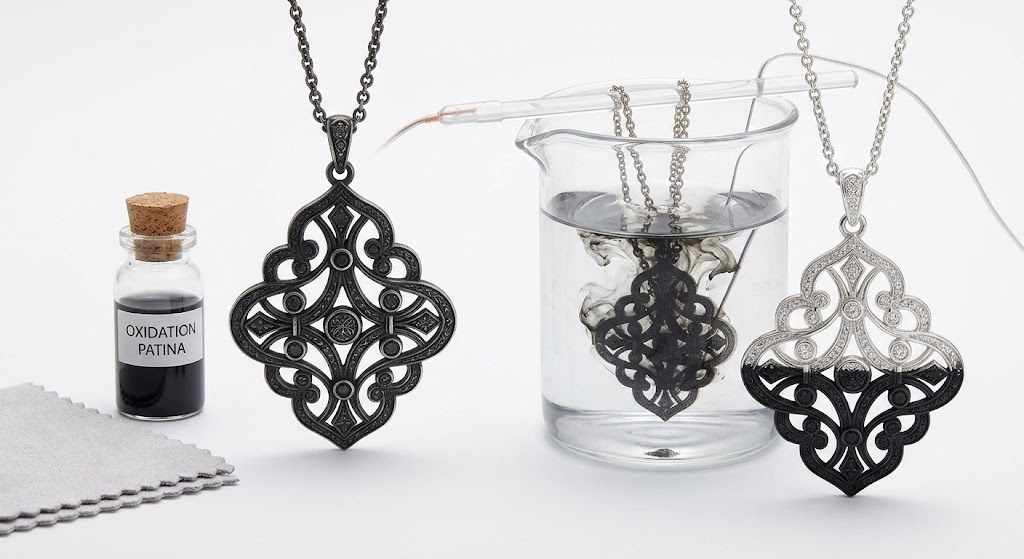
In the art of fine jewelry, oxidation (patination) is a technique that imparts depth, historical character, and striking visual contrast to metal. It is particularly popular in sterling silver pieces—especially vintage, tribal/ethnic, and men’s jewelry lines.
Let's explore what silver oxidation is, how it works technically, and what every customer should know through the eyes of a master jeweler.
Silver blackening is a chemical surface treatment process where the outer layer of silver reacts with sulfur compounds, forming a dark, tightly bonded layer of silver sulfide.
Historical Background: The art of blackening silver (notably the Niello technique) spans thousands of years, widely utilized in Ancient Rome, Byzantium, and Medieval Europe. It also holds a central position in traditional Georgian goldsmithing (such as traditional Caucasian and highland silver adornments).
The Reason: Artisans used this technique to accentuate carved patterns, engravings, and relief details, giving the piece a three-dimensional and bold visual presence.
In modern jewelry making, chemical oxidation is the standard approach:
Surface Preparation: Sterling silver (.925) undergoes thorough ultrasonic cleaning and degreasing.
Chemical Treatment: The piece is submerged in a specialized patina solution (most commonly Liver of Sulfur or specialized antiquing fluids). The liquid reacts instantly with the silver, shifting the surface color from dark brown to deep jet black.
Selective Polishing: This is the artistic stage—the jeweler uses polishing wheels to clean only the raised surfaces, leaving the rich black patina inside the recessed grooves and engravings.
The Result: A striking aesthetic contrast—mirror-polished bright silver against a matte, deep black background.
Pros:
Exclusive Aesthetic: Gives the piece a unique, antique, and artisanal character.
Enhanced Detail: Intricate engravings, textures, and filigree work become significantly more pronounced.
Low Maintenance for Tarnish: Since the piece is intentionally patinated, natural ambient tarnishing is virtually unnoticeable.
Cons:
Surface-Level Finish: Oxidation is not a full-body color transformation; it is strictly a surface treatment.
Wear over Time: On high-friction areas (like outer ring bands), the dark layer may gradually rub off.
Sensitivity to Cleaners: Dipping an oxidized piece into harsh liquid silver cleaners will instantly strip away the black finish!
In recessed areas, the dark patina lasts for decades because it experiences no mechanical friction.
Master's Care Tips:
Avoid Dip Cleaners: Never submerge oxidized silver in liquid chemical silver dips, as they will chemically dissolve the intentional black contrast.
Dry Cleaning Only: Use only a dry, soft polishing cloth to gently wipe the raised, shiny surfaces.
Keep Away from Solvents: Avoid contact with acetone, alcohol, perfumes, and harsh household detergents.
If your favorite ethnic ring or pendant loses its dark contrast over years of wear—or if you accidentally stripped it with a chemical dip—don't worry! Re-oxidizing a piece takes a bench jeweler just 5 to 10 minutes. The artisan will re-apply the patina solution, perform selective polishing, and instantly restore its rich, vintage appearance.
 511 40 73 13
 info@silveria.ge


 Eng
Eng