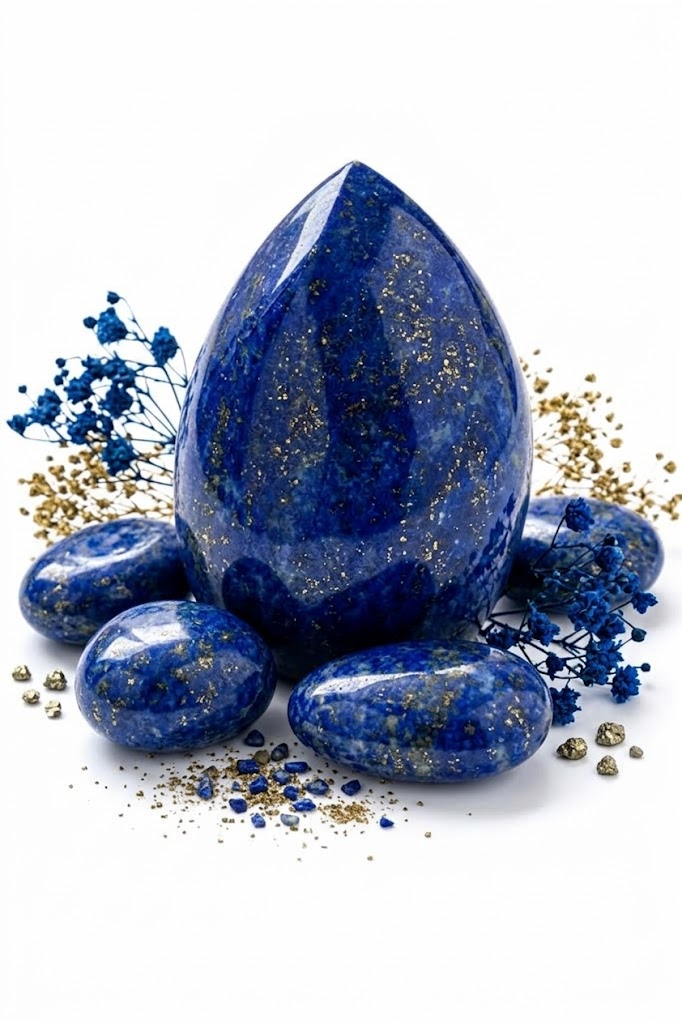
In fine and decorative jewelry arts, Lapis Lazuli stands as one of the most ancient, revered, and distinctive gemstones. It is not a single mineral, but a metamorphic rock composed of multiple minerals, famous for its deep, royal blue hue peppered with golden pyrite flecks that resemble a starry night sky.
Let's explore the origins of Lapis Lazuli, what determines its value, how it is crafted, and what every customer should know through the eyes of a master jeweler.
Lapis Lazuli is among the earliest gemstones ever mined by humanity, with history extending back over 6,000 years.
Origins & Mining: The world’s finest, most historic Lapis Lazuli is mined in Badakhshan, Afghanistan (Sar-e-Sang mines), which supplied the ancient world. Lower-grade deposits exist in Chile, Russia (Lake Baikal), and Tajikistan.
Mythology & Cultural Significance:
Ancient Egypt: Revered as a stone of gods and royalty. King Tutankhamun’s iconic golden burial mask features inlay work made of genuine Lapis Lazuli around the eyes and eyebrows.
Natural Ultramarine: During the Middle Ages and Renaissance, Lapis Lazuli was ground into a powder to create ultramarine, the most expensive pigment in the world. Masters like Da Vinci, Michelangelo, and Vermeer ("Girl with a Pearl Earring") used it exclusively for royal and sacred robes. It was once worth more than gold!
Lapis Lazuli’s unique beauty relies on a three-part mineral balance:
Lazurite: Provides the intense deep blue color.
Pyrite: Creates sparkling gold metallic flecks.
Calcite: Introduces white veining or patches (less white calcite indicates higher quality).
Processing: With a Mohs hardness of 5 to 5.5, Lapis Lazuli is relatively soft. It is rarely faceted like diamonds; instead, bench jewelers shape it into smooth cabochons, flat inlay slabs, or intricate carved beads.
Pros:
Striking Visuals: The contrast of deep royal blue and metallic gold looks breathtaking set in silver or yellow gold.
Vast Historical Heritage: Owning Lapis Lazuli means wearing a stone with 6,000 years of royal prestige.
Accessible Value: Excellent quality pieces remain accessible compared to precious blue sapphires.
Cons:
Soft Surface: Susceptible to scratches if struck against harder materials.
Chemical Sensitivity: Harsh chemicals, perfumes, soaps, and hot water can dull its natural polish.
Avoid Chemicals: Never spray perfume, hairspray, or household cleaners near Lapis Lazuli.
No Ultrasonic Cleaners: High vibrations and chemical dips can micro-fracture or strip the stone.
Cleaning: Wipe gently with a soft, slightly damp cloth and dry immediately.
Storage: Store separately in a soft pouch to prevent abrasion from harder gemstones.
When evaluating Lapis Lazuli, look for rich color uniformity. The most valuable Afghan Lapis Lazuli displays a deep, intense indigo-blue with tiny, evenly scattered specks of golden pyrite, and virtually zero white calcite veins. Heavy white streaking significantly lowers the stone's grade. Beware of cheap imitations: dyed jasper or reconstituted lapis powder are common on the market. Genuine Lapis Lazuli feels cool to the touch, and its golden pyrite flecks are naturally embedded within the stone's matrix rather than painted on the surface!
 511 40 73 13
 info@silveria.ge


 Eng
Eng