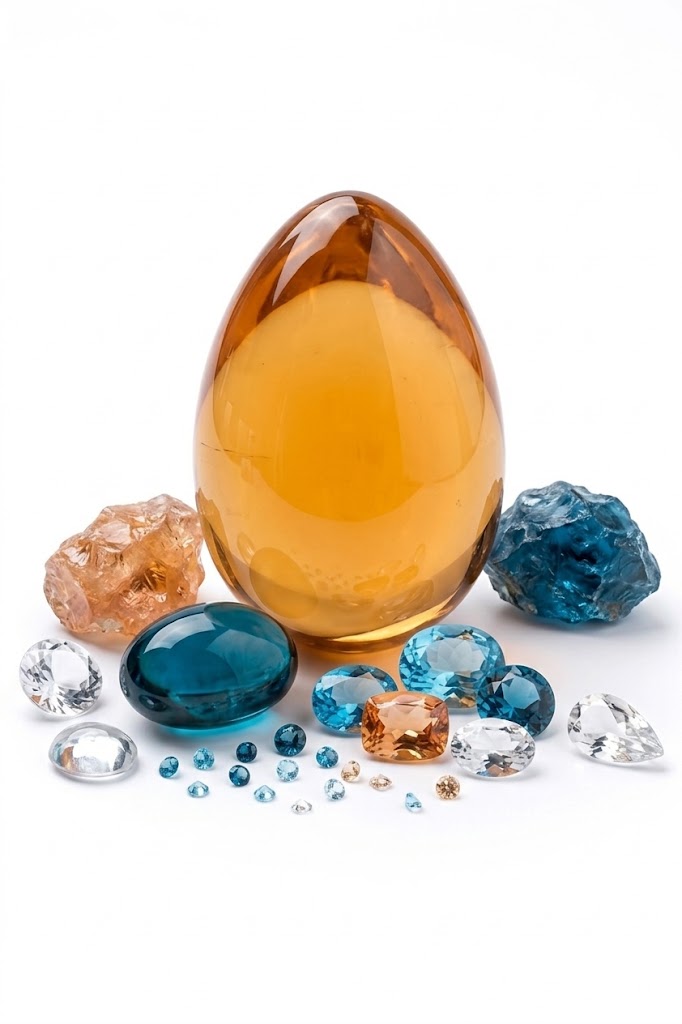
In the world of gemstones, Topaz stands as one of the most versatile, classic, and beloved choices. While it is predominantly associated with azure blue today, nature offers Topaz in a breathtaking spectrum: from rare golden-orange ("Imperial") to pink, green, and completely colorless varieties.
Let's explore Topaz's history, the chemical secrets hidden within its depths, its distinct varieties, and crucial care guidelines through the eyes of a master jeweler.
For thousands of years, topaz has been revered as a symbol of power, wisdom, and solar energy.
Etymology & Origins: There are two main versions regarding the origin of the name:
From the Ancient Greek word Topazios — the name of an island in the Red Sea (now Zabargad), where stones were mined in antiquity. However, it was later discovered that not topaz, but chrysolite (peridot) was mined there, but the name stuck.
From the Sanskrit word Tapas — meaning "fire" or "heat," referring to the golden-orange varieties of the stone.
Sources: The vast majority of the world's topaz reserves originate in Brazil (state of Minas Gerais). Brazilian topazes, especially "Imperial," are considered the benchmark. Other important deposits are in Russia (Urals), Sri Lanka, Pakistan, the USA, and Namibia.
Lore & Myths:
Ancient Egyptians: Egyptians believed that topaz was imbued with the golden radiance of the sun god, Ra. It protected the owner from evil forces and poisoning.
Ancient Romans: Romans associated topaz with Jupiter, the king of gods. They believed the stone improved eyesight and calmed anger.
Middle Ages: In Europe, it was believed that topaz had the power to enhance mental abilities, cure mental disorders, and bring wealth. It was often worn by kings and nobles as a talisman.
Chemically, topaz is an aluminum silicate containing fluorine ($Al_2SiO_4(F,OH)_2$). It is one of the hardest natural minerals (8 on the Mohs scale), making it ideal for jewelry pieces.
Primary Jewelry Varieties:
Imperial Topaz: The rarest, most precious, and prestigious variety. It has a rich golden-orange, pink-orange, or red hue. Its name is linked to the Russian Emperors, who greatly valued this stone.
Blue Topaz: Today, the most common and popular variety. In nature, true blue topaz is very rare and pale in color. Almost all blue topaz on the market is colorless topaz treated with radiation and heat to obtain a stable blue color. Three main shades are distinguished:
Sky Blue: Pale, light azure blue.
Swiss Blue: Bright, intense azure blue.
London Blue: Dark, grayish-blue or greenish-blue (the most valuable among blue topazes).
White Topaz: The most common variety in nature. Often used as an inexpensive alternative to diamond, although it does not have diamond-like play of light.
Pink and Red Topaz: Very rare and precious natural varieties.
Processing: Topaz's high hardness allows for any type of faceted cut. Cabochon cut is used only if the stone contains many inclusions.
Pros:
High Hardness: 8 on the Mohs scale, making it very resistant to scratches and suitable for daily wear (e.g., in rings).
Versatility: Available in various colors, sizes, and cuts.
Brilliance: A well-cut topaz has excellent brilliance and play of light.
Cons:
Fragility (Cleavage): Despite its hardness, topaz has perfect cleavage in one direction. This means that under strong, directed impact, the stone can split or break.
Sensitivity to Light (Some Varieties): Some natural pink or yellow topaz may fade upon prolonged exposure to direct sunlight. Blue topazes are generally color-stable.
Avoid Strong Impacts: Due to its cleavage, topaz is sensitive to impacts. Remove your ring during physical labor.
Cleaning: It is best to use warm, soapy water and a soft brush. Ultrasonic or steam cleaning is not recommended, as sudden temperature changes or vibration can cause the stone to fracture (along the cleavage plane).
Avoid Chemicals: Avoid contact with household chemicals, cosmetics, and perfumes.
Storage: Store separately in a soft pouch to avoid scratching other softer stones (or scratching the topaz itself with a diamond).
When buying topaz, especially blue varieties, it is important to know that the color is almost always artificially enhanced (Treated). This is an accepted practice in the jewelry industry and such color is stable. However, if you are offered "Imperial" topaz at a very low price, most likely it is either low-quality, dyed topaz, or a completely different stone (e.g., citrine, often sold as "Brazilian Topaz").
Genuine, natural "Imperial" is very expensive and should have a corresponding gemological certificate.
 511 40 73 13
 info@silveria.ge


 Eng
Eng