Hardness: 7
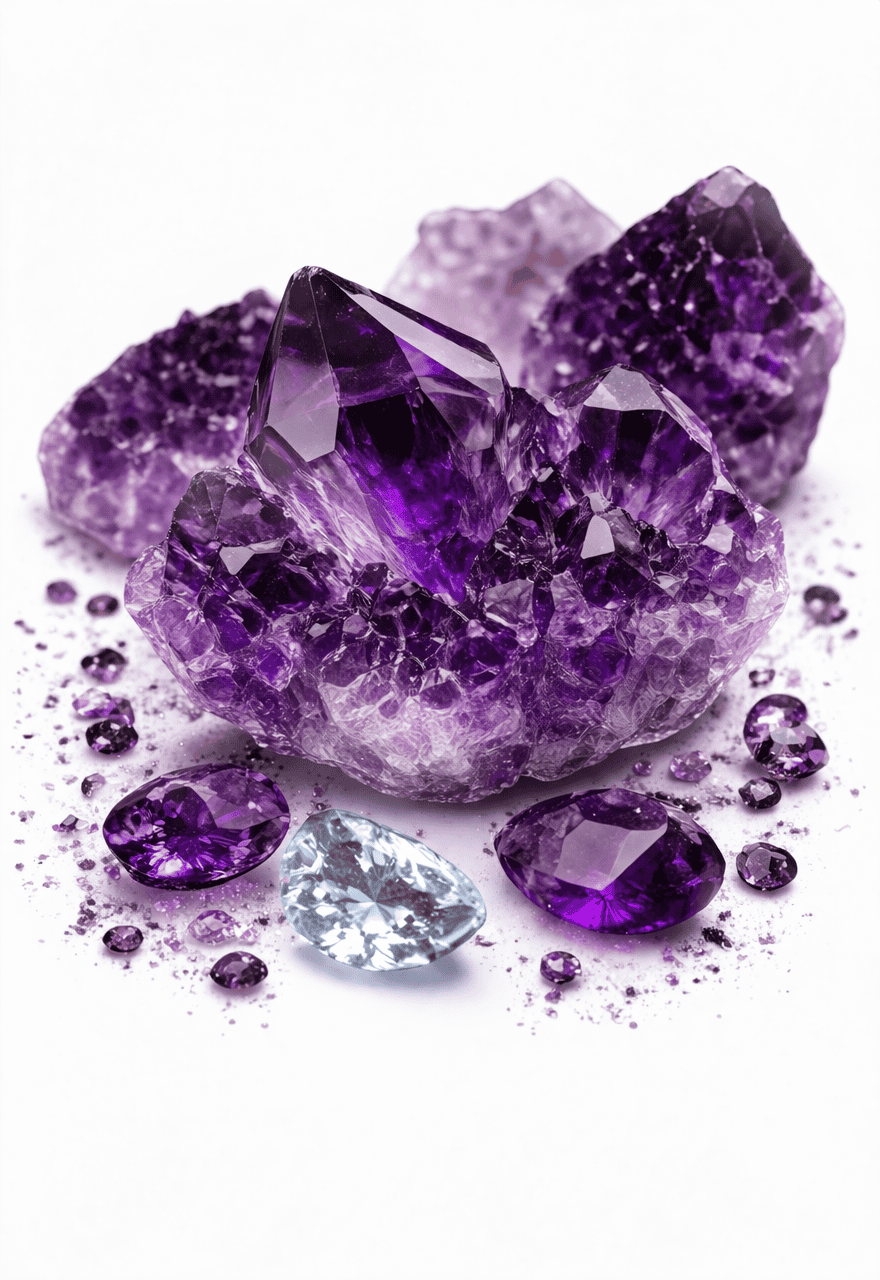
Amethyst is one of the most well-known and widespread minerals in the quartz family, belonging to the macrocrystalline variety. It is considered a semi-precious stone, yet its beauty and brilliance rival those of many precious gemstones.
In its raw form, amethyst occurs in nature as crystals of various sizes with a characteristic six-sided structure. Its primary color is purple, but the tone can range from light lavender to deep violet, sometimes appearing almost black. Blue, deep blue, green, and pink hues can also be found. Regardless of its shade, amethyst is distinguished by its remarkable brilliance, which is especially visible in sunlight.
Scientists continue to study the origin of its color. One theory suggests that iron, cobalt, and manganese are responsible for its purple hues, while another proposes that organic pigments create these beautiful tones.
Amethyst is sensitive to prolonged exposure to direct sunlight, which may cause its color to fade. Therefore, it is recommended to store it in a place protected from strong light.
Its color may also change when exposed to high temperatures. At approximately 300°C , amethyst becomes lighter and may turn yellow, green, or nearly colorless. After cooling, the color may partially return, though rarely completely.
Amethyst is mainly mined in mountainous regions. The deeper the mineral forms within the earth, the more intense and higher quality its color tends to be.
Today, the largest deposits are located in Brazil. It is also mined in Bolivia, Canada, Mexico, Madagascar, Myanmar (Burma), Namibia, Russia, Sri Lanka, the United States (Arizona), Uruguay, and Zambia. Particularly high-quality stones come from the Ural region, often referred to as “Siberian amethyst.”
Its purity and variety of shades explain its popularity in jewelry. In nature, it is rare to find a semi-precious stone that combines such beauty and quality.
Green Amethyst (Prasiolite) — A relatively rare variety with a delicate yet deep tone. It is often set in white or yellow gold. Proper cutting significantly increases its value.
Pink Amethyst — An elegant and uncommon variation. It can be transparent or slightly cloudy and is usually set in gold or platinum.
Black Amethyst — One of the rarest and most unique types. Its deep coloration forms over millions of years. Due to its rarity, it is sometimes called “Royal Amethyst.”
The name “amethyst” comes from the Greek word amethystos, meaning “not intoxicated” or “sober.” According to ancient Greek legend, the wine god Dionysus fell in love with a nymph named Amethyst. To protect her, the goddess Artemis transformed her into a violet crystal. This myth gave rise to the belief that amethyst protects against drunkenness.
In ancient times, wine goblets were decorated with amethyst, and people wore the stone during celebrations, believing it would protect them from intoxication. In China, it was used to create containers for essential oils, while in Egypt it was considered a powerful protective stone.
For centuries, amethyst has been associated with protection from excess and addiction. It is believed to reduce stress, promote emotional balance, and support spiritual growth.
Pink amethyst is linked to love, while dark purple and black varieties are considered protective stones. Traditionally, amethyst set in gold symbolizes success in business, while in silver it represents harmony and family well-being.
In alternative healing traditions, amethyst is thought to calm the nervous system, ease stress, improve sleep, and restore energy.
Amethyst is believed to suit most zodiac signs. It is especially beneficial for Libra, Aquarius, and Gemini, helping with concentration, emotional clarity, and goal achievement.
For Aries, it helps manage impulsiveness; for Taurus, it enhances stability; for Virgo, it strengthens analytical thinking; for Scorpio, it neutralizes negative energy; and for Sagittarius, it supports family harmony.
Amethyst can also be grown in laboratories. Synthetic stones have the same chemical and physical properties as natural ones, and their color can be precisely controlled. The main difference lies in color uniformity — natural amethyst typically has uneven shading, while synthetic stones tend to be more evenly saturated.
Synthetic amethyst is not considered fake; it is simply laboratory-grown rather than naturally formed.
During the Middle Ages, amethyst symbolized royal and spiritual authority. Bishops often wore amethyst rings, believing the stone protected them from temptation and enhanced wisdom. For this reason, amethyst frequently appears in royal crowns and ecclesiastical regalia.
Care and Maintenance
Clean with a soft, slightly damp cloth.
If necessary, use warm water and a very mild soap.
Then dry with a soft, dry cloth.
⚠️ Avoid:
Strong chemicals (including cosmetics and perfumes)
Prolonged exposure to direct sunlight, as it may cause the color to fade
Strong heat and sudden temperature changes
Abrasive cleaning products that may scratch the surface
Storage
Store separately in a box or a soft pouch to prevent scratches from contact with other jewelry.
It is recommended to keep the jewelry in a dry and cool place.
 511 40 73 13
 info@silveria.ge


 Eng
Eng