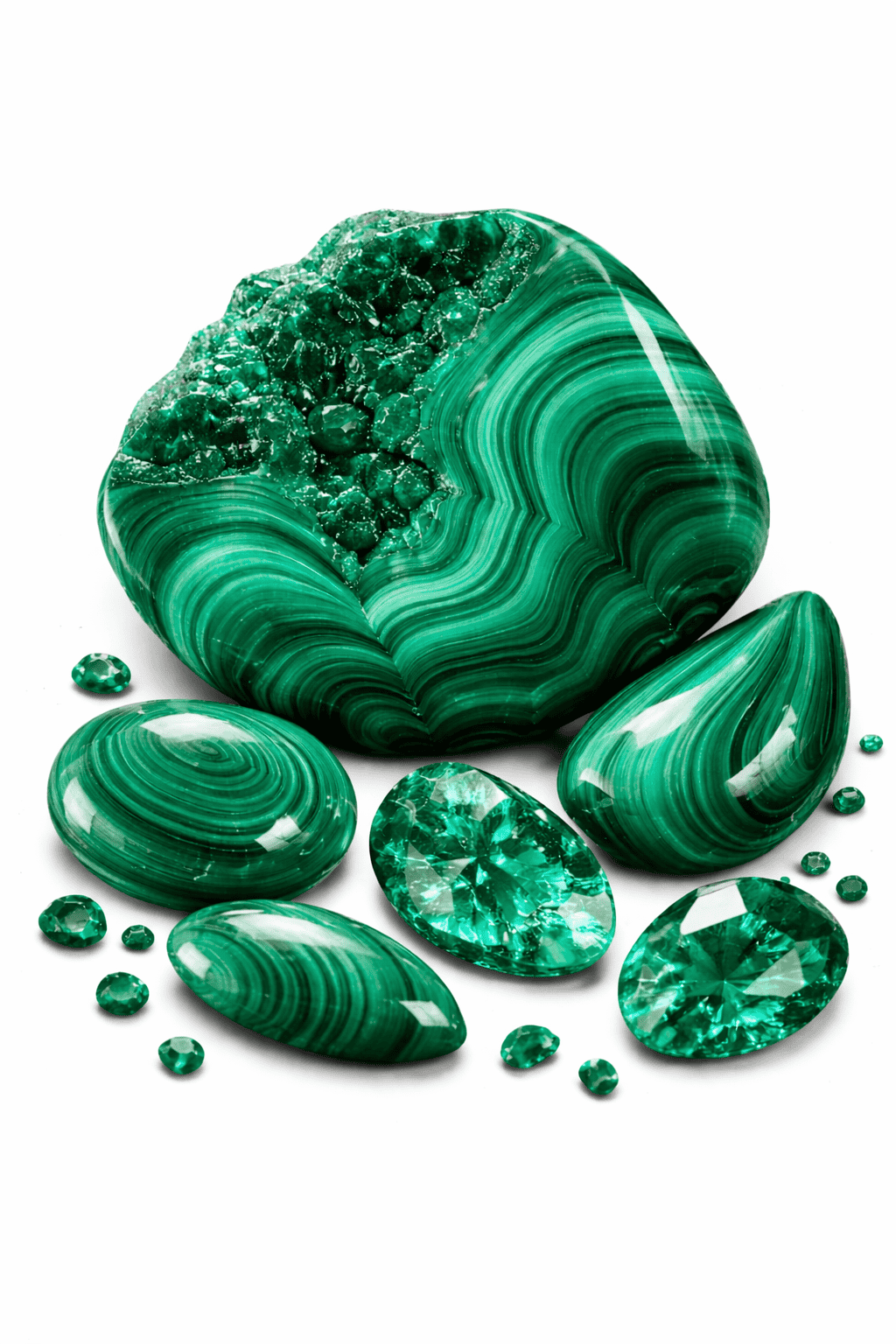
Malachite is one of the most beautiful minerals. It is characterized by an unusual pattern resembling interconnected rings of different diameters and thicknesses. This pattern is especially visible on a polished surface. The most valuable stones have thin, concentrated rings, often referred to as the “peacock eye.”
The color of malachite varies and depends on its location and origin. The name malachite comes from the ancient Greek word malakos, meaning “soft,” which reflects the delicate nature of the stone. Its hardness is 3.5–4 on the Mohs scale.
Traditionally, jewelers classify malachite into several main types based on its texture.
Turquoise-toned Malachite
Features ribbon-like green patterns, making it a favorite among jewelers.
Relatively strong and easy to work with.
Curly (Silky) Malachite
Previously considered among the more valuable varieties.
Often displays bluish or turquoise tones.
Velvet or Pleated Malachite
Its folds or granular texture are clearly visible.
Difficult to polish and process, therefore usually considered less valuable.
Finely Patterned Malachite
Patterns resemble tree rings.
Often dense and richly patterned.
Malachite can also appear in dark green or black-green tones, which give the stone a particularly elegant look.
A soft mineral that decomposes when heated and transforms into copper oxide.
Reacts with acids — it may darken or dissolve in acid while releasing carbon dioxide gas.
Easily scratched or broken; the broken surface appears velvety.
Malachite’s natural banded structure is formed through layered growth, creating circular or semicircular patterns.
Malachite has been known since the time of the ancient Egyptians, Greeks, and Romans:
It was used to create amulets and jewelry.
Its powder was used as eye shadow and textile dye.
It was believed to possess magical and healing properties, stimulating the body and helping calm the nervous system.
In the 18th century, malachite was widely used in architectural decoration, including mosaics and wall designs. In some cases, entire rooms were decorated with this stone.
Considered a stone of financial prosperity and harmony.
In esoteric traditions, malachite is regarded as the birthstone of May, believed to be strongest at the end of spring.
Said to suit the zodiac signs Libra, Taurus, and Leo best.
Traditionally believed to attract the opposite sex.
Often recommended to be worn with silver, which is believed to reduce aggression and negative energy.
Also considered a protective talisman for children.
A country historically famous for malachite is Russia, where large quantities were mined in the past.
Although Russia was once the main supplier of malachite, its reserves have decreased over time. Today, Africa is considered the main source of the stone. Malachite can also be found in Australia, Chile, Namibia, Zimbabwe, and Arizona.
Because natural malachite deposits are gradually decreasing, imitations are common on the market. These are often made from plastic or glass and sometimes sold at the price of natural malachite.
In natural malachite, color transitions are smooth and natural, while synthetic stones often show only 3–4 colors and irregular bands.
Natural stone is cool and heavy, while plastic imitations feel warmer and lighter.
Natural malachite may turn white when exposed to ammonia, while fake stones do not change color. (Note: this test may damage the stone.)
The most reliable sign of natural malachite is its circular banding and layered structure, which synthetic stones cannot accurately reproduce.
Clean with a soft, slightly damp cloth.
If very dirty, use warm water and a very mild soap.
Then dry with a soft dry cloth.
⚠️ Avoid:
Strong chemicals (including cosmetics and perfumes)
Ultrasonic or steam cleaning
Acids (lemon, vinegar, etc.)
Water: prolonged soaking may damage the surface
Sun and heat: may cause the color to fade
Store separately in a box or soft pouch to prevent scratches.
 511 40 73 13
 info@silveria.ge


 Eng
Eng