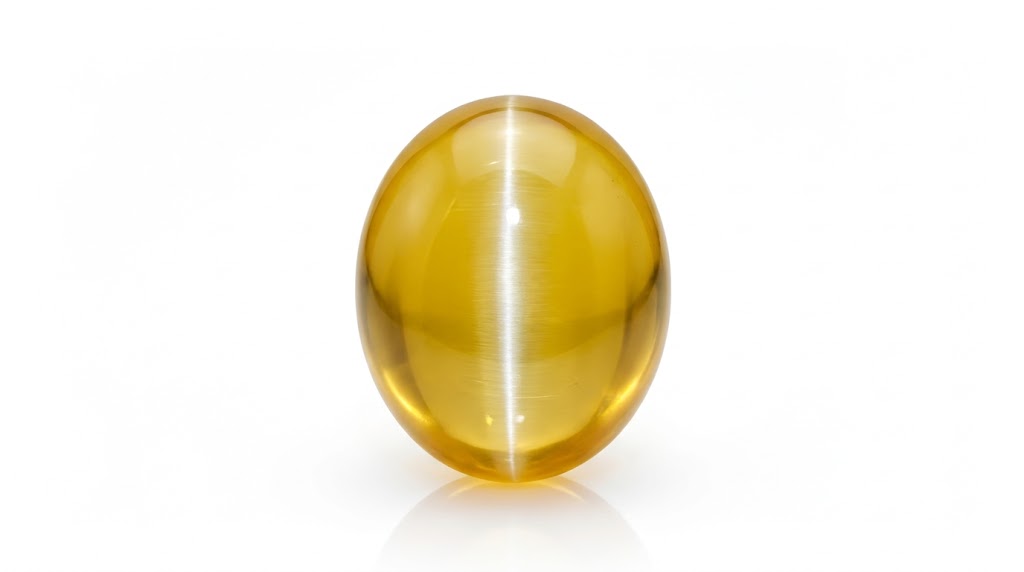
Cat's Eye (Cymophane) — Ocean of Optical Illusion, Chatoyance, and Master's Secrets
In gemology, the term "true Cat's Eye" belongs exclusively to the variety of chrysoberyl (BeAl2O4) that exhibits a specific optical phenomenon known as chatoyancy. However, a similar effect can also be observed in other minerals (such as quartz, tourmaline, apatite, and sillimanite), which are accordingly designated as "quartz cat's eye," "tourmaline cat's eye," and so on.
Chrysoberyl cat's eye (cymophane) possesses a unique characteristic: when light strikes the surface of the stone, a sharp, mobile band of white or silvery light appears, closely resembling the slit eye of a cat.
Through the eyes of a master craftsman, cat's eye represents one of the most rigorous tests of lapidary skill. Maximizing the chatoyant effect depends entirely on the precise alignment of the stone's internal fibrous inclusions and fashioning an ideal cabochon.
Historical Significance: In Eastern cultures (particularly in India, Sri Lanka, and China), cat's eye was regarded for centuries as a potent protective amulet. In the late 19th century, when Prince Arthur, Duke of Connaught, presented a cat's eye ring to his fiancee, the gemstone achieved unprecedented popularity among European high society.
"Milk and Honey" Effect: A defining hallmark of top-grade cymophane. When light illuminates the stone from the side, one half displays a milky-white hue while the opposite half retains a translucent honey or golden shade.
Energy and Spiritual Significance: In lithotherapy and Vedic astrology (Jyotish), cat's eye (the stone of Ketu) is considered a powerful shield against the evil eye, misfortune, and financial loss. It is aligned with the Solar Plexus (Manipura) chakra. It is believed to foster intuition, discipline, and inner fortitude in its wearer.
When working with cat's eye, a lapidary artist must account for its high hardness and the precise orientation of its internal parallel channels and inclusions.
Chemical Formula:(BeAl2O4) (Beryllium aluminate — Chrysoberyl group).
Crystal System: Orthorhombic.
Hardness (Mohs Scale): 8.5 (Exceptionally high hardness; surpassed only by diamond and corundum).
Density: $3.70 - 3.78 \text{ g/cm}^3$
Cleavage: Weak / Distinct in one direction.
Refractive Index: $1.744 - 1.755$
Optical Effect: Chatoyancy — light reflection off microscopic, parallel needle-like rutile ($\text{TiO}_2$) inclusions or hollow micro-channels within the chrysoberyl structure.
Color: Honey-yellow, golden-yellow, greenish-yellow, brown, olive-green.
Luster: Vitreous, silky along inclusion planes.
Sri Lanka: The historic source for the world's finest chrysoberyl cat's eye exhibiting the prized "milk and honey" effect.
Brazil: The primary modern exporter of top-grade cymophane.
India, Madagascar, Russia (Urals), Zimbabwe, and Myanmar (Burma).
High Jewelry: Natural chrysoberyl cat's eye ranks among the highest tiers of precious gemstones. It is set into exclusive gold and platinum creations (signet rings, fine rings, and pendants).
Collecting: Large specimens featuring a sharp, narrow, and highly mobile light ray command extraordinary prices at international auctions.
Faceting Orientation: Chatoyancy manifests only when shaped as a cabochon. The lapidary master must orient the rutile needles flawlessly: the base of the cabochon must run parallel to these needles, while the apex of the dome sits perpendicular to them. Misaligned cutting yields a crooked, asymmetrical, or entirely absent light ray.
Sharpness of the Light Ray: Key quality benchmarks include the ray's brightness, narrowness, and mobility — as the stone is tilted, the line of light should glide smoothly across the dome.
Care and Maintenance:
Caution: With a high hardness of $8.5$, the stone is exceptionally durable and scratch-resistant, though it should still be protected from heavy impacts.
Cleaning: Clean with warm soapy water and a soft brush. Ultrasonic cleaning is generally safe (provided the gemstone lacks deep open fractures).
 511 40 73 13
 info@silveria.ge



 Eng