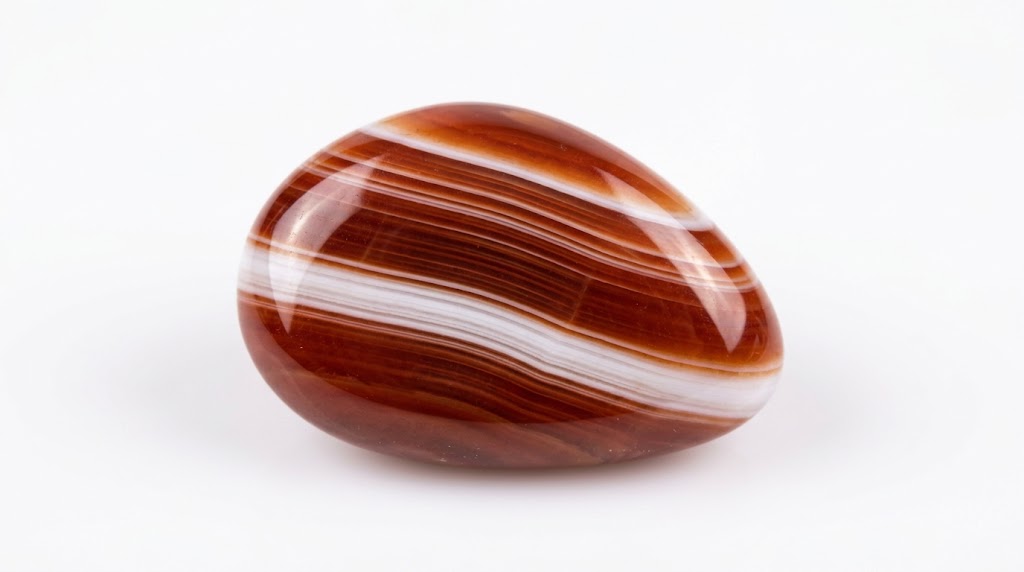
Sardonyx — Layered Grandeur, Antique Seals, and Master's Secrets
Sardonyx ($\text{SiO}_2$) is a banded, layered variety of the agate and chalcedony family, characterized by alternating parallel layers of reddish-brown (or orange-red) sard/carnelian and white (or dark gray/black) onyx. The name "sardonyx" directly combines two words: "sard" (brownish-red chalcedony) and "onyx" (Greek Onyx — fingernail), pointing to its distinctive banded structure.
Through the eyes of a master craftsman, sardonyx is the absolute king of glyptic art — the sculpting of cameos and intaglios. Its sharply defined, parallel colored layers allow jewelers and gem carvers to carve a relief design (such as a portrait) on the upper white layer, using the darker layer beneath as a striking, high-contrast background.
Ancient Rome and Signet Rings: In the Roman Empire, sardonyx was an exceptionally prized stone. Roman senators and military commanders used it to carve personal signets. Similar to carnelian, polished sardonyx possesses a unique property: melted wax or wax-sealed documents do not adhere to its polished surface.
Protector of Armies and Warriors: Roman legionnaires wore sardonyx amulets engraved with images of Mars (the god of war) or Hercules. It was believed that the stone granted fighters fearlessness, discipline, and victory.
Energy and Spiritual Significance: In lithotherapy, sardonyx is regarded as a stone of marital harmony, stability, and enduring partnership. It is connected to the Root (Muladhara) chakra. It is believed to safeguard its owner from deception, reduce stress, and foster self-control.
When working with sardonyx, a lapidary craftsman must take into account its microcrystalline, layered structure and the uniformity of its bands.
Chemical Formula: $\text{SiO}_2$ (Silicon dioxide — Chalcedony/Agate group with iron oxide impurities).
Crystal System: Trigonal (cryptocrystalline aggregate).
Hardness (Mohs Scale): 6.5 - 7.0 (High hardness; highly resistant to scratching).
Density: $2.58 - 2.64 \text{ g/cm}^3$
Cleavage: None (Waxy or conchoidal fracture).
Refractive Index: $1.530 - 1.540$
Color: Alternating layers of red-brown or orange-red with white, milky, or gray bands.
Luster: Waxy to silky, becoming vitreous upon polishing.
Diaphaneity: Translucent to opaque.
India (Gujarat): For centuries, India has been and remains the primary source of sardonyx with the sharpest, most distinct layering.
Brazil and Uruguay: Major global suppliers of raw material.
Madagascar: Renowned for highly saturated, contrasting banded specimens.
USA, Germany (Idar-Oberstein — historic lapidary center), and Russia (Urals).
Glyptic Art (Cameos and Intaglios): Sardonyx is the premier choice for carving relief portraits and signet rings.
Jewelry Art: Featured in signet rings for both men and women (often engraved with family crests), bracelets, beads, and pendants.
Decorative & Ornamental Art: Caskets, small carvings, and decorative vessels.
Orientation During Cutting: The lapidary's primary task is precisely aligning the layers horizontally during cutting. When carving a cameo, the white layer is utilized for the raised figure, while the lower brownish-red layer serves as the background.
Artificial Dyeing: Many "sardonyx" pieces on the market are actually common agates that have been chemically and thermally dyed (e.g., using honey and acid solutions). Natural sardonyx colors are softer and more organic.
Care and Maintenance:
Durability: A hardness of $6.5-7.0$ ensures high resistance to daily wear, though it should still be kept away from aggressive chemicals and heavy impacts.
Cleaning: Easily cleaned using warm soapy water and a soft cloth.
 511 40 73 13
 info@silveria.ge


 Eng